
Do you suffer from low back pain? Have you tried to stretch and massage it out but to no avail? It may be your Psoas!
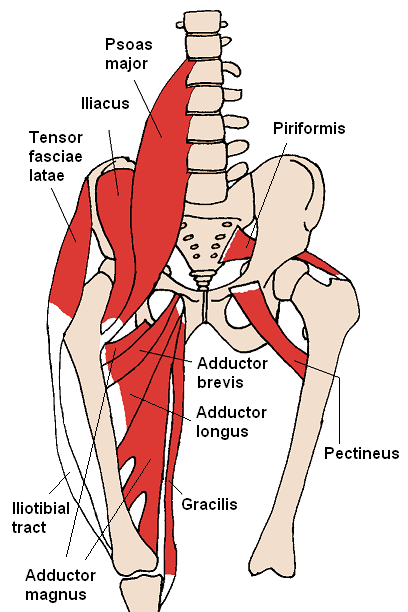
So, what is a Psoas? Your Psoas is a long ribbon-shaped muscle starting at the anterior side of the spine at T-12 to L5; from there it runs through your pelvis to the top of your femur (thigh bone). It’s one of the core muscles in your abdomen and a major hip flexor. The major role of the Psoas is to stabilize the spine when you are sitting down. Additionally, it pulls your abdomen up from a face-up position; much like a sit up. The actions of the Psoas is also responsible for flexion and lateral rotation of the thigh at the hip.
At this point you may be asking yourself, “what does a tight Psoas feel like?” A contracted Psoas may present itself as dull aching in the low back. You may also feel pain, weakness or numbness in the front part of the thigh to the groin area. It even may be difficult to stand up straight after sitting for long periods of time. This all happens because when the muscle gets tight it pulls and twists the vertebrae leading to compression of the disc and can lead to entrapment of the femoral nerve.
If you are wondering, “how did it get like this?” There are several ways this muscle gets tight. The most common being sitting for long periods. This shortens the muscle causing strain on the vertebrae we talked about before. You can also strain and inflame the muscle through intense exercise that requires continuous hip flexor motion like running, cycling, dancing or rowing. Lifting heavy objects incorrectly will also aggravate this muscle. A little less common way that the Psoas may get contracted is emotional trauma, stress or anxiety.
Luckily, there are several things you can do to relieve the Psoas. Try to avoid sitting or standing still for long periods. Gentle chiropractic adjustments can be utilized to reduce the stress on the joints. Massage therapy will target specific muscles to physically work out the tension. Stretching at home is extremely important to keep your Psoas muscle happy and healthy.
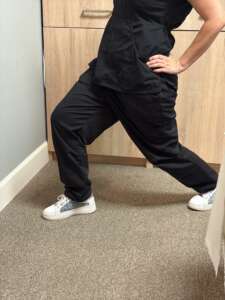
As for a simple stretch you can do at home to start your healing journey right away there is the basic lunge. You may prefer to use a blanket, yoga mat or pillow underneath the knee.
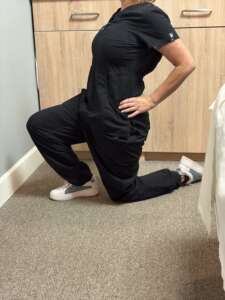
Step 1. Drop your left knee down beneath you, with your leg extending away from your body and your toes touching the ground.
Step 2. Place your right leg in front of you (with your foot flat on the ground) so that your right leg forms about a 90 degree angle. Using the strength from your buttock gently drive your left knee backwards and down. While doing this maintain a good posture with your shoulders tall and head upright.
Step 3. Hold this position for 30 seconds and repeat with the other side. Try to do this stretch 2 to 3 times daily.
If you suffer from knee issues, you may want to try the variation below.